Your Eyes Are Lying to You: How Portion Creep Quietly Undoes Your Best Efforts
There's a moment that happens in almost every American kitchen. You pour cereal into a bowl, glance down, and think: that looks like one serving. It isn't. It's usually closer to two, sometimes three. And the wildest part? You're not being careless. You're being normal.
We've All Been Calibrated Wrong
Portion distortion isn't a personal failing — it's an environmental one. Restaurant entrees have grown steadily since the 1980s, and packaged 'single-serve' items have quietly stretched along with them. A bagel that once weighed about two and a half ounces now routinely tips the scale at four or more. The muffin at your local coffee shop? Frequently labeled as one serving while packing the calories of an entire breakfast for two.
When the world around you supersizes, your brain recalibrates. What registers as 'a normal plate of pasta' drifts upward year after year, and nobody sends you a memo. Research on portion perception consistently shows that people eat significantly more when served larger amounts — and they don't feel any fuller afterward. The extra calories essentially fly under the radar of your hunger signals.
Why Calorie Apps Can't Fix This
Here's the contrarian part: the problem usually isn't tracking. It's the data going into the tracker. If you log 'one cup of rice' but actually spooned out two and a half, your app is faithfully recording fiction. You can be meticulous, diligent, and consistent — and still be off by 400 to 600 calories a day without ever knowing it.
Studies comparing self-reported intake against measured intake have found that people, on average, underestimate what they eat by a meaningful margin. Not because they're dishonest, but because eyeballing is a skill nobody ever taught us — and we learned it in an era of ever-expanding plates.
The Two-Week Recalibration
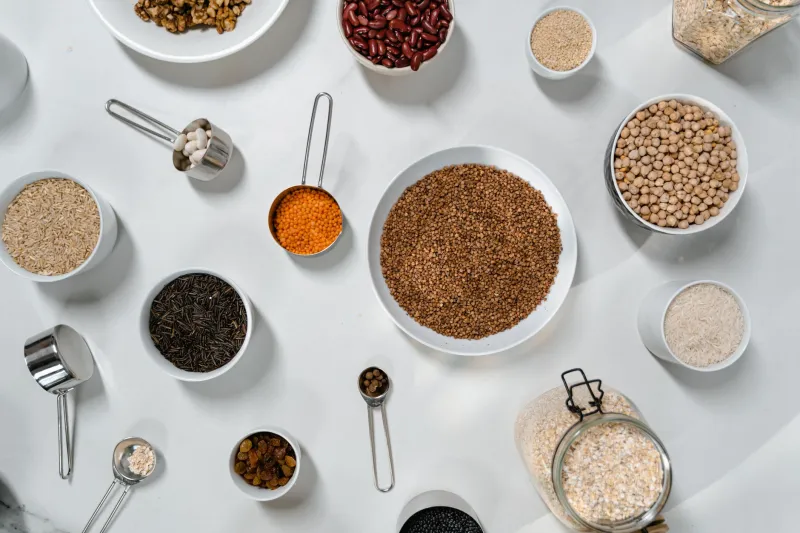
The good news? Your internal compass can be retrained, and the tool costs less than a vending machine snack. A full set of measuring cups and spoons runs about a dollar at most big-box stores. Here's the protocol:
Week one: measure everything you serve yourself. Not forever — just long enough to gather evidence. Cereal, pasta, rice, peanut butter, salad dressing, the cheese you shred over tacos. Scoop it, level it, then pour it into your usual bowl or plate and look at it. This is the crucial step. You're not just measuring; you're re-teaching your eyes what a half cup of cooked rice actually looks like in your favorite dish.
Week two: guess first, then verify. Before you scoop, estimate the serving. Then measure and compare. Most people are shocked to find they overestimate healthy foods and underestimate calorie-dense ones — a double penalty that works directly against weight loss goals.
After two weeks, something clicks. The visual anchor of 'one cup' gets burned into your memory, and you can carry that calibration to restaurants, holidays, and your mother-in-law's Thanksgiving table.
A Few Shortcuts Worth Knowing
Once your eyes are retrained, you can lean on some low-effort anchors:
- Your fist approximates one cup for most people
- Your palm (minus fingers) is roughly three ounces of meat or fish
- Your thumb is close to a tablespoon
- A deck of cards matches a standard serving of chicken or steak
None of these are lab-precise. That's fine. Precision matters most for calorie-dense foods like oils, nut butters, and cheese — measure those. For spinach and broccoli, close enough is genuinely close enough.
The Bigger Picture
Nobody's arguing that tracking apps are useless. For many people, they build awareness that simply didn't exist before. But if you've been logging faithfully for months and the scale isn't budging, the problem probably isn't your discipline or your app. It's that the numbers you're entering were never real.
Fix the inputs, and the outputs tend to follow. Nine cents, two weeks, and a little humility in front of the cereal box. That's the whole program — and honestly, it might do more than the $60 monthly subscription you've been side-eyeing.